

A small agency's account manager resigns with twenty client relationships in her inbox. The company needs continuity, but another employee casually asks for her password to save time.
Employee turnover is both an operational handoff and a security event. Access, retention, customer promises, and ownership need separate decisions.

Try InboxCabin free for 30 days. No credit card required.
 Start Free Trial
Start with the actual failure point
To locate the real cause, trace one recent message from arrival to final outcome. Where did it land? Who first saw it? Who was authorized to respond? Did the answer depend on a hidden rule or an individual remembering what to do? That walkthrough often reveals an ownership or routing issue that no new notification sound would solve.
Map the incoming messages: inventory relevant accounts
Work with IT and managers to identify company-owned mailboxes, aliases, shared mail, client contacts, and in-flight commitments. Don't hunt through personal accounts.
Name the accountable person: revoke access using policy
Disable or adjust access at the provider, reset organization-controlled secrets where appropriate, and review recovery methods. Preserve records through approved retention procedures.
Create a repeatable handoff: reassign relationships
Give each active client one new contact and confirm which entity should send future messages. A forwarding rule without ownership can hide unresolved work.
Use a weekly exception review: review a week later
Check bounced mail, wrong auto-replies, and messages still routed to the old owner. Remove temporary workarounds when the transition stabilizes.
A realistic example: from message to resolution
Consider the original situation again: A small agency's account manager resigns with twenty client relationships in her inbox. The company needs continuity, but another employee casually asks for her password to save time. The improved version begins with a clear destination and ends with a recorded outcome. The account visible in the desktop app tells the employee where they are working; the ownership log, billing system, or approved shared-mailbox process tells them what action is authorized. Those two functions are complementary, not interchangeable.
A usable record for employee departure business email checklist can start as a compact shared log. Include the mailbox, accountable person, status, next action and due date; also record the factors unique to this process: revoke access using policy and reassign relationships. Use an approved CRM, finance or case-management system once the process requires access controls, audit history or team reporting.
What not to do
Do not export an employee's private correspondence outside legal and HR policy, or reuse their device login to access mail.
A predictable failure in this workflow is that “revoke access using policy” lives only in one employee’s memory. When that person is absent, the team returns to guesswork. Prevent this by keeping instructions where the authorized backup owner can access them and by practicing the handoff before the situation becomes urgent.
How to know whether it is working
Measure abandoned threads, redirect failures, access revocation timeliness, and customer confusion reports.
Where InboxCabin fits—and where it does not
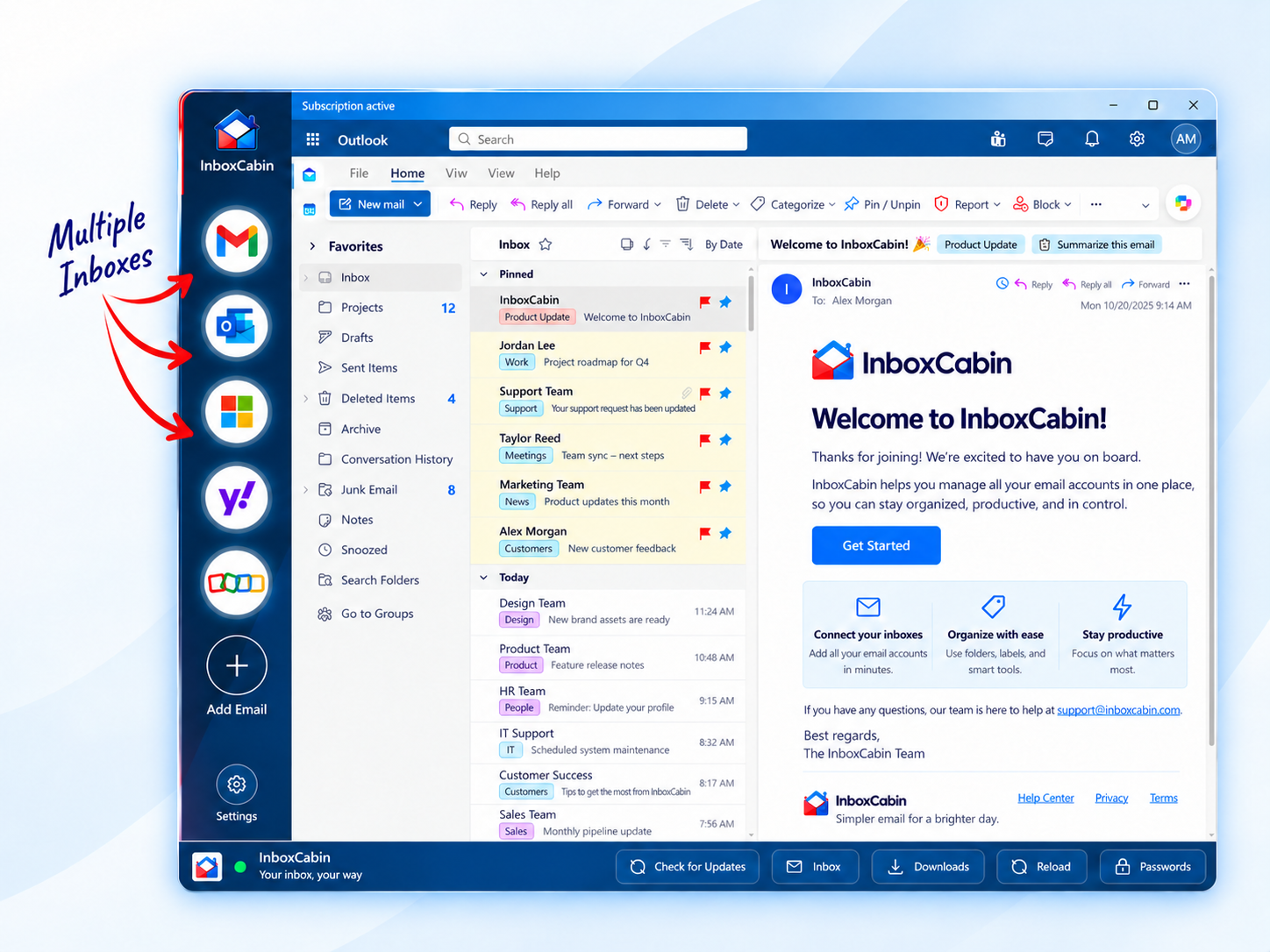
InboxCabin keeps separate Gmail and Microsoft webmail accounts accessible in one Windows desktop application. It supports navigation between accounts; it does not assign conversations, approve business decisions, or grant permission to use another person’s mailbox. Keep ownership, access controls, and records in your provider and approved business systems.
For provider guidance and technical background, see this official resource. Always review current settings and policy before changing access, rules, or retention.
For related setup guidance, see managing several email accounts and avoiding replies from the wrong account.
Takeaway
The real win is not simply a cleaner-looking inbox. It is a repeatable process that turns messages into clear next actions. Start by addressing the specific failure described here: Employee turnover is both an operational handoff and a security event. Access, retention, customer promises, and ownership need separate decisions. Once responsibility, timing, and account identity are obvious, the number of inboxes becomes much less intimidating.
Try InboxCabin free for 30 days. No credit card required.
Examples in this article are illustrative, not customer case studies or promises of results.