

An unhappy customer contacts a salesperson. The salesperson forwards the message to support, which forwards it to billing, and the customer starts over each time someone replies.
Escalations fail when forwarding substitutes for ownership and the customer must repeatedly restate the same facts.

Try InboxCabin free for 30 days. No credit card required.
 Start Free Trial
Start with the actual failure point
To locate the real cause, trace one recent message from arrival to final outcome. Where did it land? Who first saw it? Who was authorized to respond? Did the answer depend on a hidden rule or an individual remembering what to do? That walkthrough often reveals an ownership or routing issue that no new notification sound would solve.
Define the scope: acknowledge once
Tell the customer who owns the issue and when they will hear next; avoid copying five employees into an unmanaged thread.
Write down the decision rule: create a case record
Store key facts, current owner, next action, and due time in the agreed CRM or ticketing tool.
Make the workflow visible: keep one outward voice
Let internal specialists collaborate behind the scenes while one accountable contact communicates with the customer.
Stress-test the edge cases: confirm resolution
Close the loop with a concise outcome and make sure the same problem is not left active elsewhere.
A realistic example: from message to resolution
Consider the original situation again: An unhappy customer contacts a salesperson. The salesperson forwards the message to support, which forwards it to billing, and the customer starts over each time someone replies. The improved version begins with a clear destination and ends with a recorded outcome. The account visible in the desktop app tells the employee where they are working; the ownership log, billing system, or approved shared-mailbox process tells them what action is authorized. Those two functions are complementary, not interchangeable.
A usable record for customer complaint email workflow can start as a compact shared log. Include the mailbox, accountable person, status, next action and due date; also record the factors unique to this process: create a case record and keep one outward voice. Use an approved CRM, finance or case-management system once the process requires access controls, audit history or team reporting.
What not to do
Do not promise a refund, legal result, or repair date without approval from the appropriate decision-maker.
A predictable failure in this workflow is that “create a case record” lives only in one employee’s memory. When that person is absent, the team returns to guesswork. Prevent this by keeping instructions where the authorized backup owner can access them and by practicing the handoff before the situation becomes urgent.
How to know whether it is working
Track customer repeat explanations, handoff count, and time from complaint to final response.
Where InboxCabin fits—and where it does not
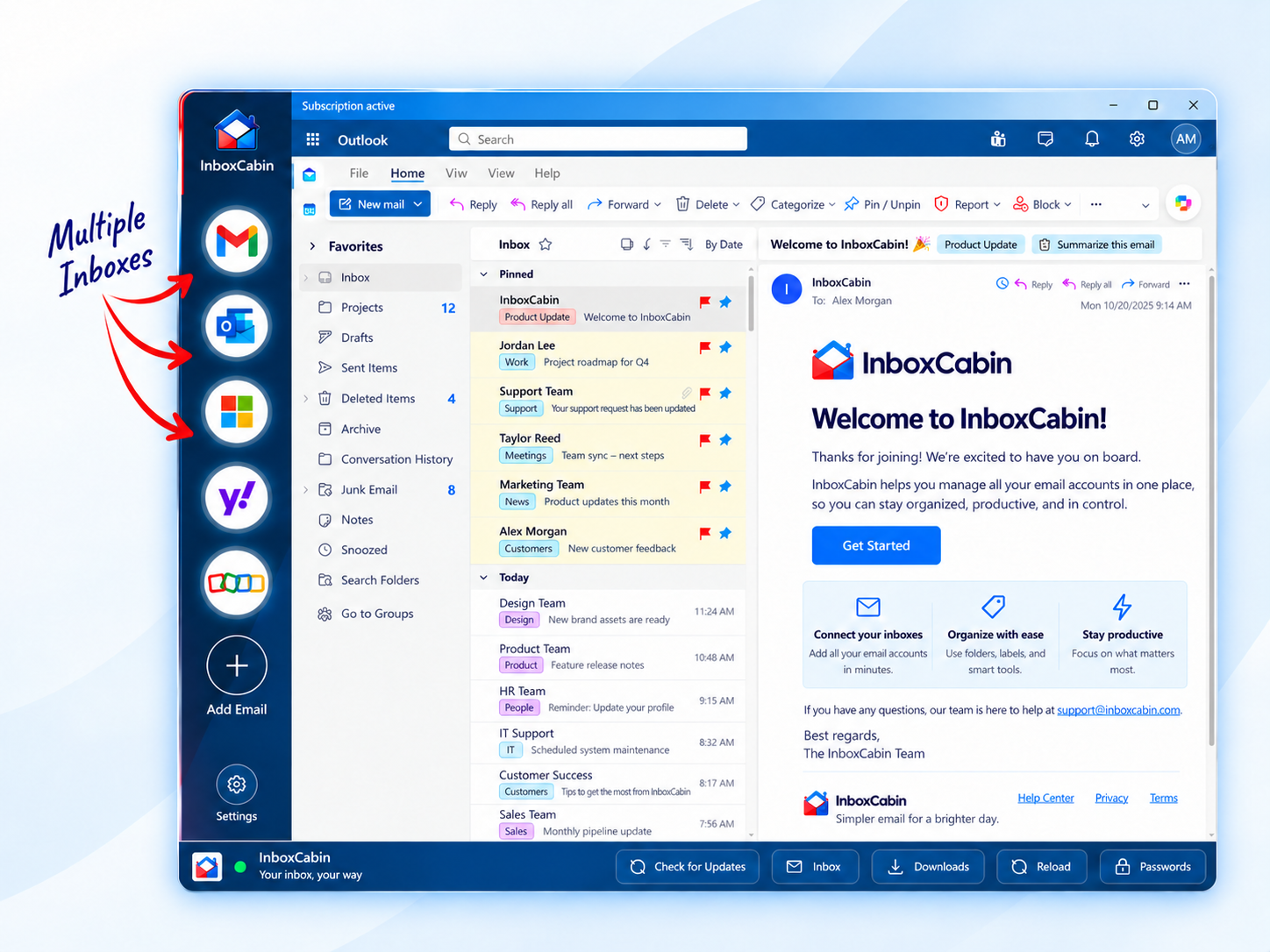
InboxCabin keeps separate Gmail and Microsoft webmail accounts accessible in one Windows desktop application. It supports navigation between accounts; it does not assign conversations, approve business decisions, or grant permission to use another person’s mailbox. Keep ownership, access controls, and records in your provider and approved business systems.
For provider guidance and technical background, see this official resource. Always review current settings and policy before changing access, rules, or retention.
For related setup guidance, see managing several email accounts and avoiding replies from the wrong account.
Takeaway
The real win is not simply a cleaner-looking inbox. It is a repeatable process that turns messages into clear next actions. Start by addressing the specific failure described here: Escalations fail when forwarding substitutes for ownership and the customer must repeatedly restate the same facts. Once responsibility, timing, and account identity are obvious, the number of inboxes becomes much less intimidating.
Try InboxCabin free for 30 days. No credit card required.
Examples in this article are illustrative, not customer case studies or promises of results.