

An email takes three minutes less to write. Eight colleagues then spend longer reading it. Has the company become more efficient? The answer depends on the extra reading, the quality of the message, and any clarification or correction that follows. A stopwatch on the sender’s desk cannot settle a question about the whole team’s work.
That does not make AI-assisted writing a false economy. It means the unit of analysis matters. A tool can genuinely help one employee while helping the organization more, less, or not at all. The useful question is not whether a draft appeared quickly. It is whether the communication accomplished its purpose with less total effort and acceptable quality.
This feature connects published AI experiments to a transparent, adjustable accounting model. One illustrative result captures the issue: a three-minute drafting saving can disappear when a message adds 180 words for four full-reading recipients, after an assumed thirty seconds of extra review. Those inputs are hypothetical. The calculation is not a measured effect of AI or a recommendation to count everyone’s words.
Research and commercial disclosure: This is an InboxCabin editorial research synthesis and original illustrative calculation, not a new experiment or an independently peer-reviewed study. None of the cited research tested InboxCabin. Published findings and modeled scenarios are kept separate. There are no customer testimonials or invented company results.

Try InboxCabin free for 30 days. No credit card required.
 Start Free Trial
Three different questions often become one misleading headline
“Does AI improve productivity?” might mean at least three things. Can a person finish a defined writing assignment faster? Does access to an integrated assistant change time spent in workplace applications? Does the entire organization complete useful work with less effort or better outcomes?
Those questions require different evidence. A randomized writing task can provide a strong answer about that assignment without measuring recipients. Application telemetry can reveal changed behavior without establishing the correctness of a response. A team-level evaluation must account for work transferred between people and for what the communication ultimately achieves.
The distinction also applies to the denominator. A 40% reduction in completion time is not the same statistic as a 40% increase in output per hour. If a hypothetical task falls from ten minutes to six, its time falls by 40%, while the maximum task rate rises from six to ten per hour, about 67%. Neither calculation establishes what happens during a real day with other constraints.
When reading a headline, therefore ask: faster at what, for whom, under what conditions, and with what quality check? These questions make the evidence more useful, not less encouraging.
What a controlled writing experiment actually found
Noy and Zhang’s 2023 experiment involved 453 college-educated professionals completing occupation-related writing tasks. Access to ChatGPT reduced average completion time by 40% and increased evaluator-rated quality by 18%. The study supports benefits for the assessed assignments, not a blanket estimate of corporate email efficiency. 1
The workplace implication is a hypothesis worth testing: a writer may produce a useful first draft more efficiently. What happens after that draft still needs to be measured. A professional response might require private context, a current price, an authorization, or a decision that no writing tool can infer reliably from a generic task description.
A stronger draft can also create value without saving time. The employee might use the released minutes to check the answer, remove ambiguity, or make a difficult explanation more understandable. An evaluation focused only on speed could miss that benefit.
Conversely, a polished response that omits the requested decision can be a poor outcome even when it reads beautifully. Quality needs a work-specific definition: correct facts, complete answer, appropriate authorization, clear action, and suitable tone. Grammar alone is an inadequate substitute.
What a workplace experiment adds—and the metric it cannot supply
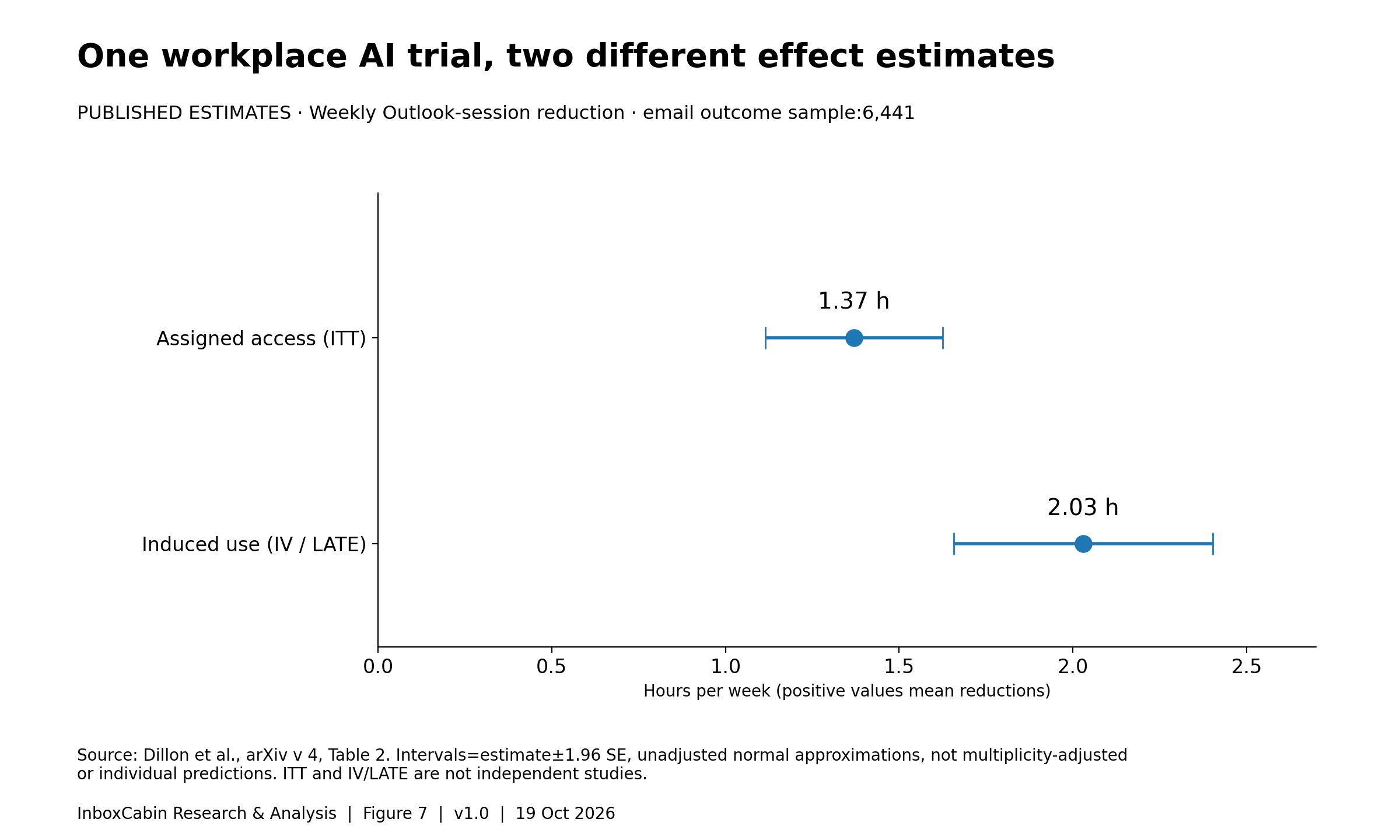
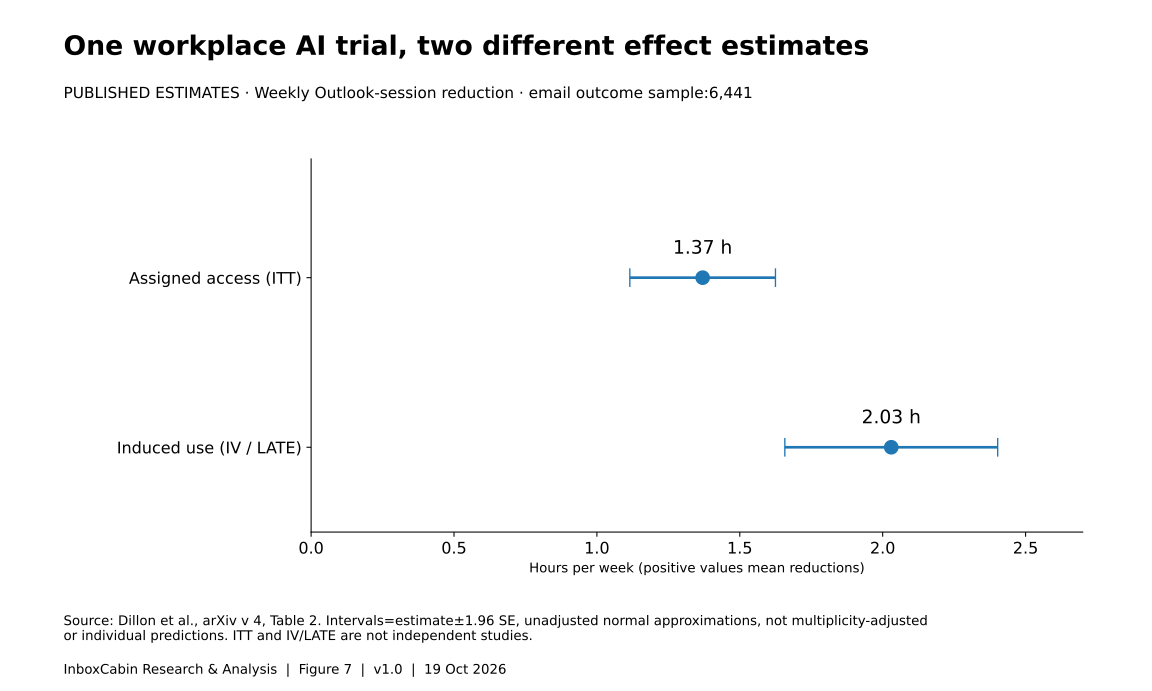
Dillon and colleagues report a six-month randomized study covering 7,137 workers at 66 firms. Table 2 of the retrieved manuscript reports weekly Outlook-session reductions of 1.37 hours for assignment to access and 2.03 hours for the instrumental-variable estimate of use; the email analysis includes 6,441 workers. 2
Read the chart data as a table
| estimand | reduction hours | se hours | normal 95 low | normal 95 high |
|---|---|---|---|---|
| Assigned access (ITT) | 1.37 | 0.13 | 1.115 | 1.625 |
| Induced use (IV / LATE) | 2.03 | 0.19 | 1.658 | 2.402 |
Selected display values. Download the CSV for all rows and full precision; see caption for evidence type and units.
The outcome is an activity-based session proxy, not directly observed productive labor: reading events separated by less than fifteen minutes define sessions, and activities can overlap. The researchers did not observe work content or performance ratings. They did not detect increased counts of replied-to threads, meetings, or completed Word documents. 2
These findings are valuable without turning them into a company-wide output claim. They make it reasonable to investigate integrated AI in actual workflows. They do not allow a reader to price every reduction in session time as labor eliminated or to assume more messages were produced.
Why “assigned access” and “used the tool” are different estimates
An intention-to-treat estimate asks what changes when people are assigned access, including people who rarely or never adopt the tool. For a company buying licenses, that is often a useful management question. The decision being made is access provision, not a guarantee of intensive use.
An instrumental-variable estimate asks a different question under additional identification assumptions. It uses randomized assignment to isolate a component of use that would otherwise be entangled with motivation, task fit, and other differences between adopters and nonadopters. It is not simply an average of enthusiastic users compared with everyone else.
The two estimates should not be averaged, added together, or treated as two independent confirmations. They describe the same experiment from different perspectives. Neither is a promise about a particular employee, a different tool, or a future version of that tool.
The interval calculation also has limits. The chart reconstructs a conventional estimate-plus-or-minus-1.96-standard-errors interval. It is not the study’s multiple-testing procedure, a prediction interval for an employee, or a range covering all business contexts. A narrow statistical interval does not remove uncertainty about transferring a result into another organization.
Build a whole-workflow time account
A practical model can start with six quantities for a comparable communication task:
- Manual writing time: preparation and drafting under the current method.
- AI-assisted writing time: prompting, generation, selection, and ordinary editing under the proposed method.
- Additional review time: extra verification beyond the review already included in the baseline.
- Change in message length: additional words, or a negative number when the new version is shorter.
- Reading exposure: how many equivalent full readings those changed words receive.
- Additional follow-up effort: the change in clarification, correction, or rework across everyone involved.
In minutes, a simplified equation is:
Net time saved = manual writing − AI-assisted writing − extra review − (extra words × full-reading equivalents ÷ reading rate) − extra follow-up effort.
Every term is a difference between comparable workflows. Do not charge the AI version for review that the manual version also requires. Do not count ordinary editing twice. If the AI version reduces rework, the follow-up difference can be negative, increasing the saving.
The model also needs a quality constraint: both versions must accomplish the same legitimate task to an acceptable standard. A shorter answer that fails to communicate an important condition is not an efficiency gain. The equation counts time; it does not decide what constitutes an adequate answer.
This is an accounting framework rather than a validated productivity instrument. Its value is that the missing costs become visible and adjustable.
A worked example: when the recipients change the answer
Assume manual writing takes six minutes and AI-assisted writing takes three. Assume an additional half-minute of verification, 180 additional words, and no change in follow-up effort. These are selected scenario inputs, not estimates taken from the experiments above.
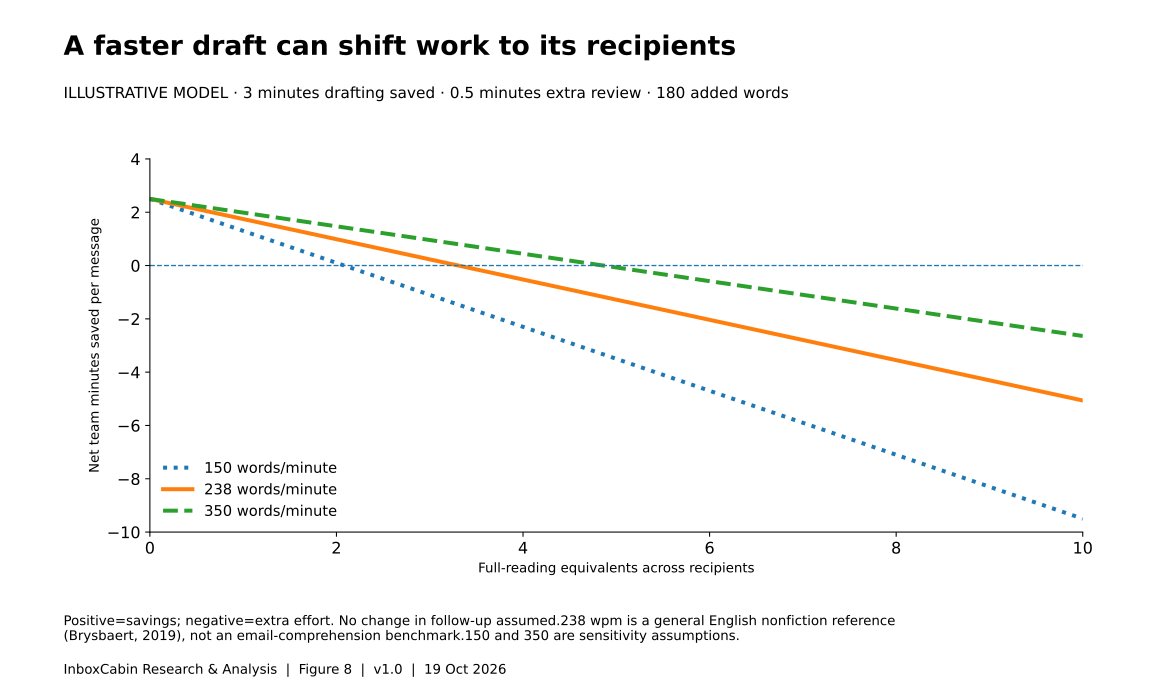
For a reading-speed reference, Brysbaert’s 2019 meta-analysis combined 190 studies and 18,573 participants and estimated adult English silent nonfiction reading at 238 words per minute. That is not an email-comprehension or decision-making benchmark. We use it only as one transparent scenario value alongside slower and faster assumptions. 3
At 238 words per minute, one complete reading of 180 extra words takes about 0.76 minutes. With one reader, the modeled net saving is approximately 1.74 minutes. With three, it is 0.23 minutes. With four, it becomes a 0.53-minute net cost. With eight, the added reading and review exceed the drafting saving by about 3.55 minutes.
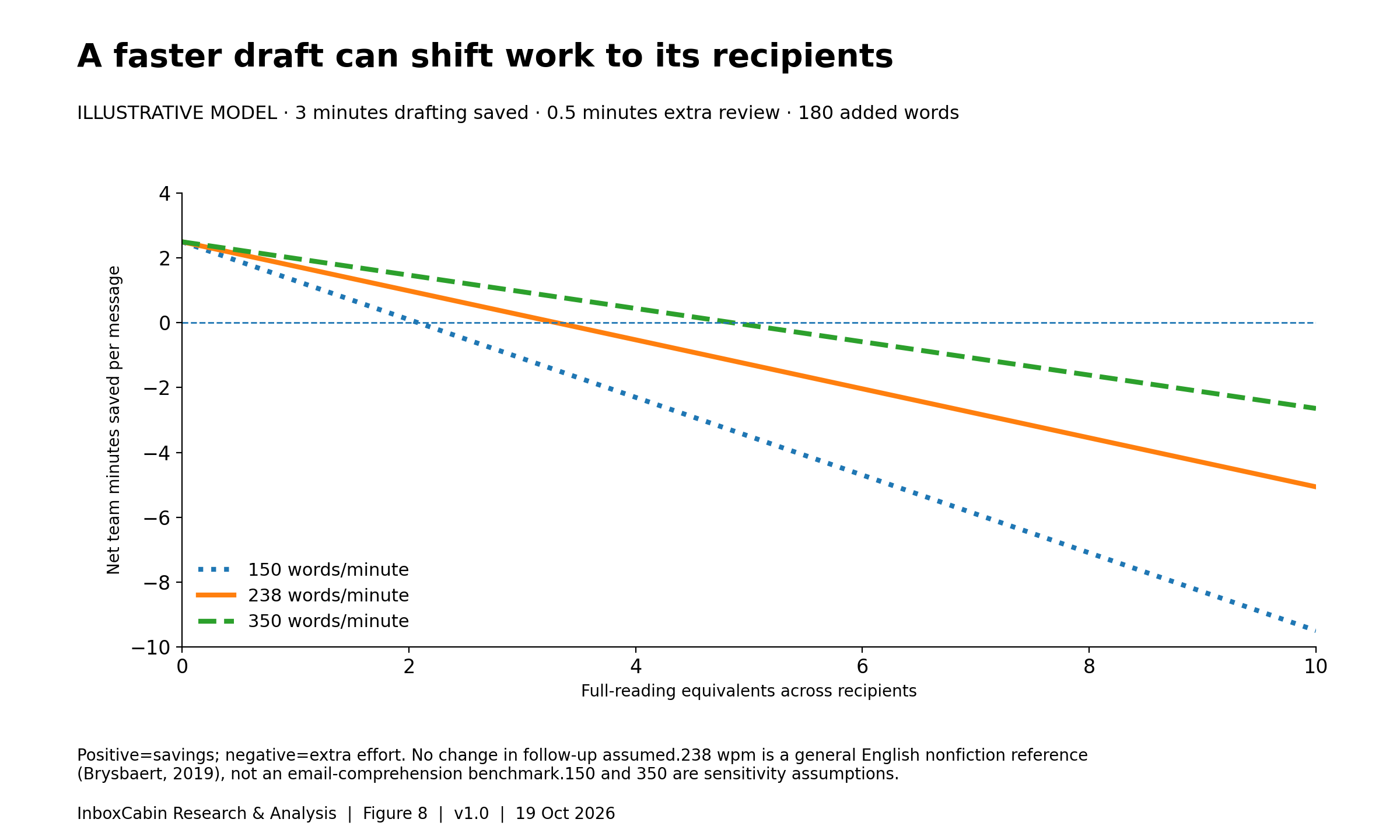
Read the chart data as a table
| full reading equivalents | reading wpm | net minutes saved |
|---|---|---|
| 1 | 238 | 1.744 |
| 3 | 238 | 0.231 |
| 4 | 238 | -0.525 |
| 8 | 238 | -3.55 |
Selected display values. Download the CSV for all rows and full precision; see caption for evidence type and units.
Under the central assumptions, break-even occurs at about 3.31 full-reading equivalents. This does not mean a fourth name in a CC field necessarily destroys value. Some people skim, some never open the message, and some read it more than once. The model concerns reading exposure, not the address count alone.
The conclusion is narrower and more useful: distribution multiplies the consequences of message design. A small change to a widely read message deserves more attention than the same change to a private exchange.
AI can improve the recipient side too
The previous example intentionally tests expansion. It does not assume that AI always makes messages longer. An assistant can help remove repetition, identify a missing question, or turn scattered notes into an actionable summary. Whether it succeeds is an empirical question for the chosen workflow.
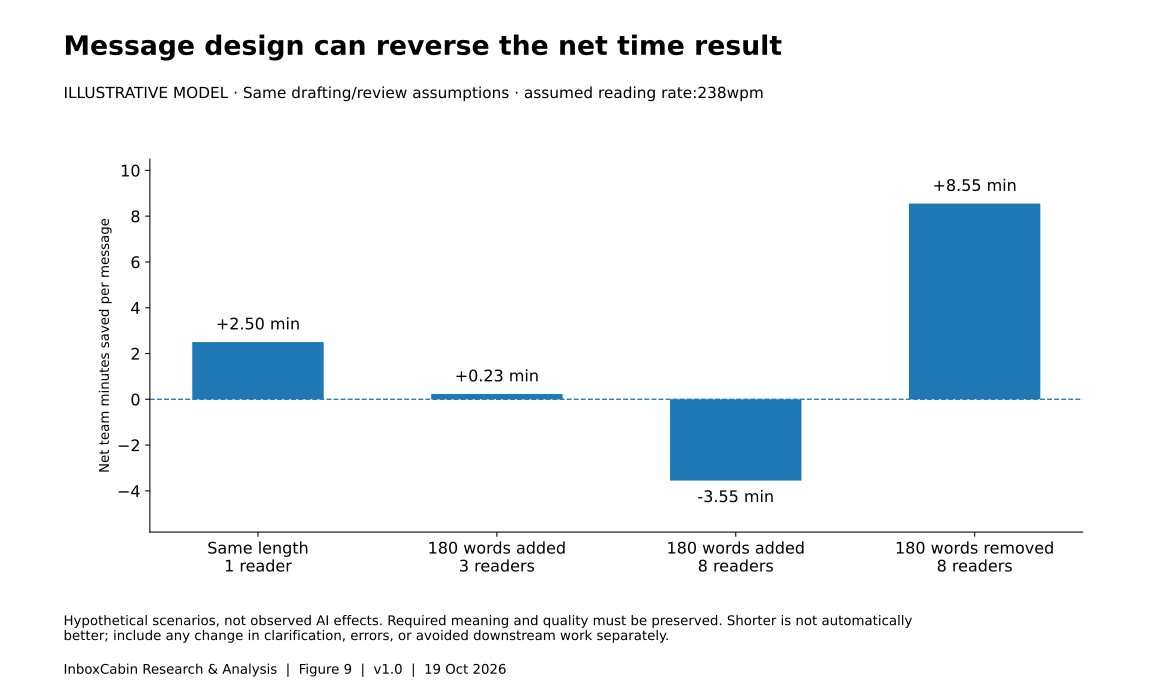
Keep the three-minute drafting saving and half-minute additional review. If length is unchanged and follow-up effort does not change, the modeled saving is 2.5 minutes regardless of audience size. If the new version adds 180 words for eight full readers, the result is a 3.55-minute cost. If it instead removes 180 unnecessary words for those eight readers, the result becomes an 8.55-minute saving.
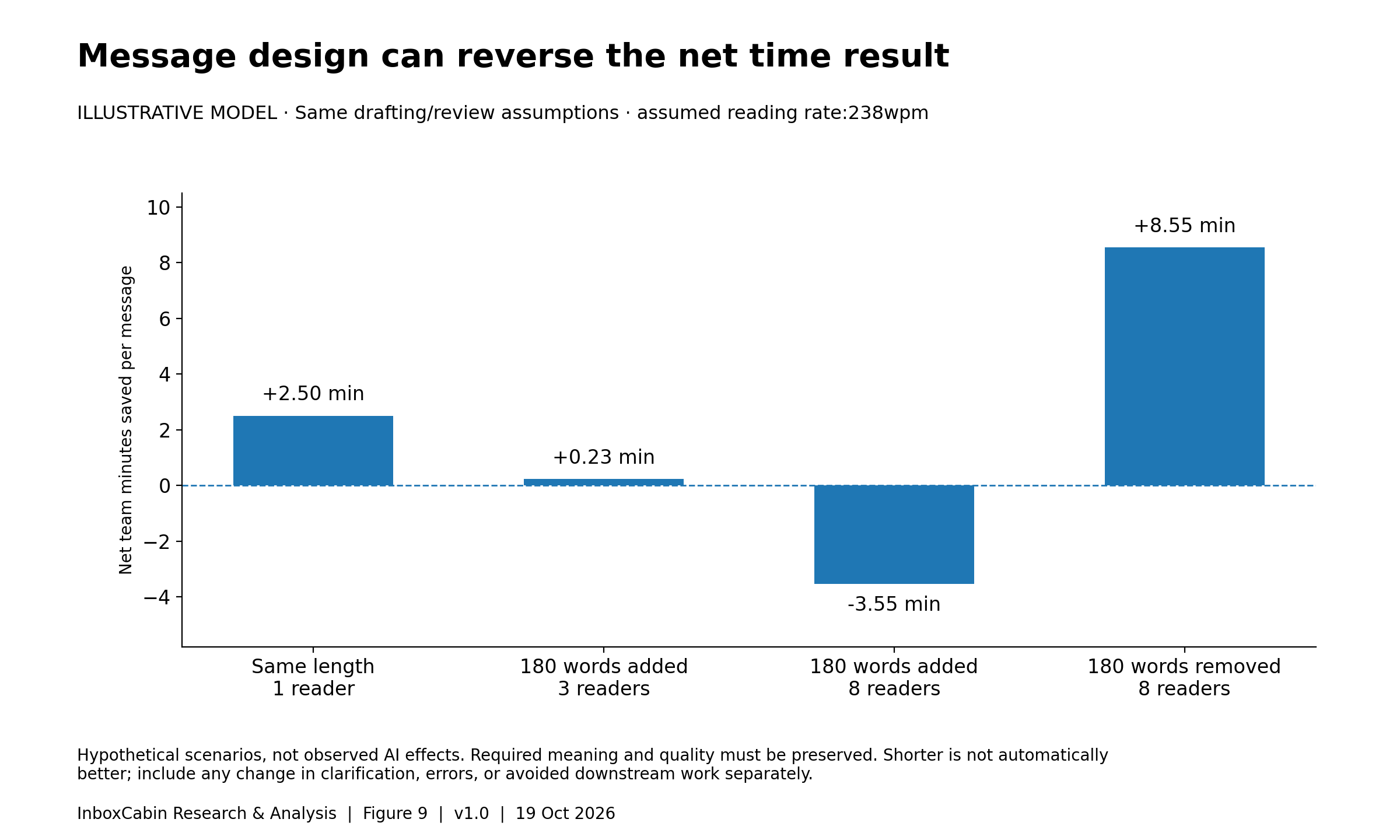
Read the chart data as a table
| scenario | net minutes saved |
|---|---|
| Same length; 1 reader | 2.5 |
| 180 words added; 3 readers | 0.231 |
| 180 words added; 8 readers | -3.55 |
| 180 words removed; 8 readers | 8.55 |
Selected display values. Download the CSV for all rows and full precision; see caption for evidence type and units.
The third scenario is not an instruction to make every message shorter. A slightly longer message may avoid a meeting or an expensive misunderstanding. Add that downstream benefit to the analysis when there is evidence for it. What matters is useful information delivered at reasonable total cost, not minimal word count.
This also explains why a tool may perform differently by message type. A routine acknowledgment has little room for savings. A carefully structured decision memo may repay additional drafting effort many times over. Grouping both into an average email statistic can hide the difference.
Add the work that follows the first reply
Consider a hypothetical response that saves two minutes today but has a one-in-ten additional chance of requiring a twenty-minute correction tomorrow. The expected extra correction effort is two minutes. Under those assumptions, the expected time benefit is gone before recipient reading is considered.
This is not an estimated AI error rate. It is a demonstration of why even infrequent rework can matter. Use observed rates from an authorized sample when available, and show a range when they are uncertain. Do not take an unrelated model benchmark and treat it as your firm’s email mistake probability.
Rework also belongs to more than the sender. A recipient who asks for clarification, a manager who checks an unsupported commitment, and a colleague who corrects an attachment all contribute time. Record these costs once, at the person or stage where they occur, so the calculation does not double count them.
Some consequences should not be traded for a few saved minutes. Unauthorized promises, disclosure of sensitive information, and incorrect high-stakes instructions can make a draft unacceptable even when the expected time calculation looks favorable. Establish those boundaries before optimizing the workflow.
Design email around an answer, not around a generated draft
A useful prompt begins with the job the message must accomplish. State the reader’s question, the verified facts, the allowed commitment, and the requested next action. Treat missing information as missing; a confident sentence is not a substitute for a source.
Then decide what the recipient needs first. A direct answer or explicit decision request usually deserves the opening, with context below and supporting detail available where appropriate. The exact format depends on the audience. A legal notice, a technical incident update, and a customer scheduling reply should not be compressed into the same template.
A review can use five questions: Is the answer correct? Is the requested action clear? Are dates, names, and amounts verified? Is anything promised without authority? Can a recipient act without guessing? These are suggested checks, not a validated scorecard.
For a long distribution list, perform a second review focused on reader effort. Remove repetition, identify the decision owner, and separate required action from background information. The goal is not to optimize a readability score. It is to reduce unnecessary interpretation while preserving the information needed to make a good decision.
A dedicated inbox workspace is a different intervention
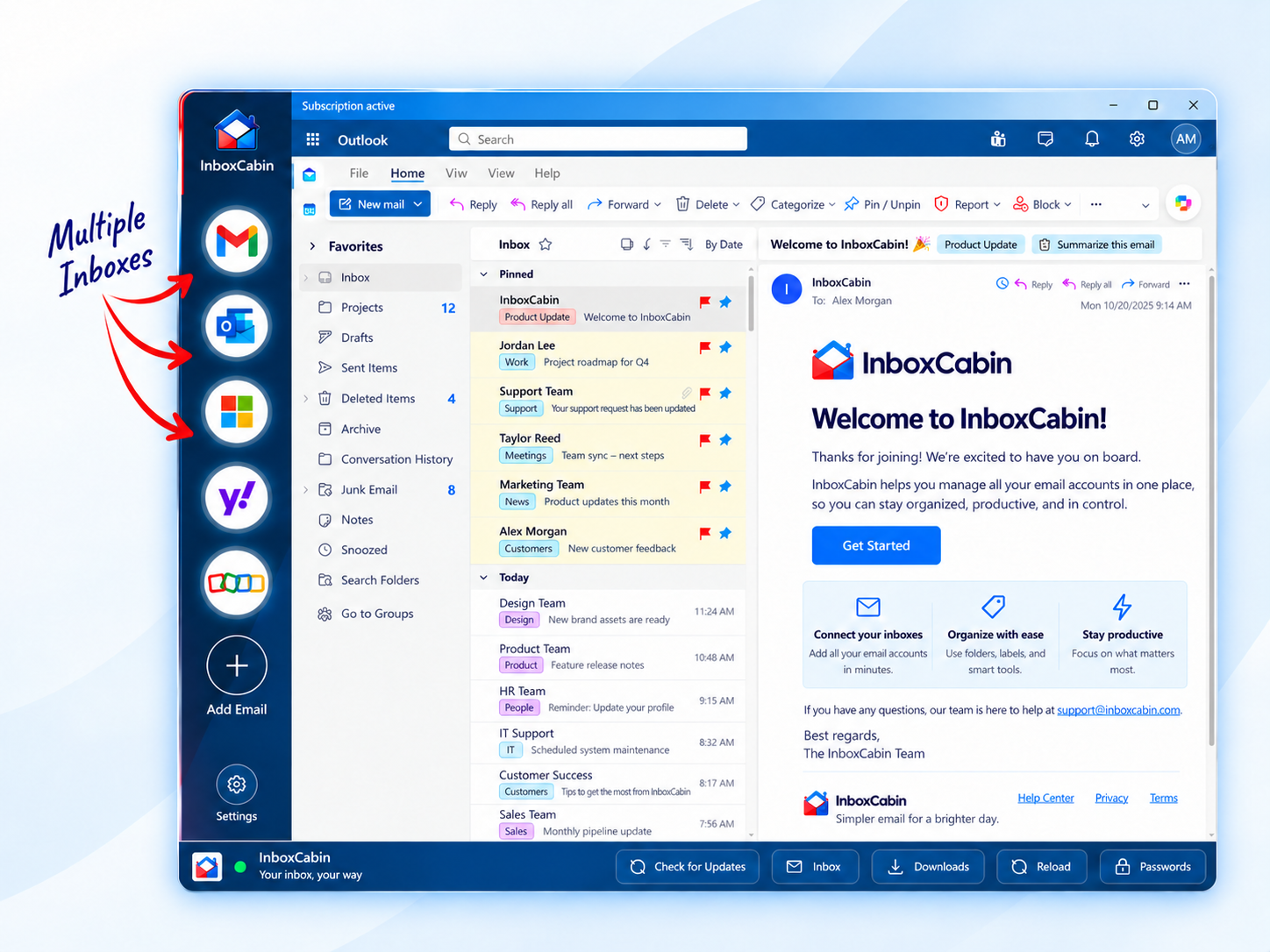
InboxCabin provides a Windows workspace for switching between separate Gmail and Microsoft inboxes. Its role is account navigation and organization, not generating or validating email. It does not supply the treatment tested in the cited AI studies, and their findings should never be used as evidence of InboxCabin performance.
The practical connection is that communication work has several stages. A team might improve drafting, account navigation, or task ownership independently. Test the stage that is actually creating friction. If reaching the correct inbox is a problem, a dedicated workspace may be worth evaluating; if content accuracy is the problem, changing the window around the inbox is not the answer.
How to test AI email without mistaking activity for value
Start with one task class, such as routine supplier status requests. Exclude sensitive or high-consequence work until the organization’s approved processes are clear. Define an acceptable response before introducing the tool: correct status, accurate date, appropriate audience, and an explicit next step.
Use comparable tasks and, where feasible, randomize which method is used. A crossover design can let the same volunteers try both methods, but use different comparable messages so prior knowledge does not give the second condition an unfair advantage. Counterbalance the order and allow enough practice that the trial does not measure only first-day confusion.
Collect active writing and review time, not just how long the application was open. Sample recipient effort voluntarily and proportionately. A brief timing exercise on authorized, redacted examples can answer more than continuous monitoring of private correspondence. Do not ask participants to expose confidential message contents for a marketing experiment.
Assess outcomes as well as speed. Have an appropriate reviewer score correctness and actionability against a predefined rubric, preferably without knowing the drafting method. Record whether another clarification was needed and whether the request was resolved. Document messages that failed the quality threshold rather than quietly excluding them.
Report the sample size, task mix, tools and versions, training, comparison method, missing observations, and variability. A small internal experiment supports a local operating decision. It does not establish that every employee or every company will receive the same benefit. Preserve null results and cases where the manual method worked better.
Evaluate money separately from minutes
Time released is not automatically a cash saving. Employees may complete more useful work, improve quality, reduce overtime, or simply experience less pressure. Which outcome occurs depends on demand and on how the organization uses the capacity.
A financial calculation should therefore separate subscription cost, training and administration, actual overtime avoided, and any measured operational value. Multiplying all estimated minutes by salary may describe a theoretical capacity value; it does not prove that payroll fell by that amount.
The same caution applies to per-message economics. A tool that is excellent for a small number of complex responses may be worthwhile despite low usage. A tool used hundreds of times for unnecessary updates may produce impressive activity statistics without useful returns.
Before scaling, ask which work improved, whether recipients noticed, and whether the cost of maintaining the process is reasonable. Adoption is evidence that a tool is being used. It is not, by itself, evidence that the organization is better off.
Methods, source selection, and limits
This is a targeted narrative synthesis checked on October 19, 2026. It combines a controlled writing experiment, a randomized workplace study, and a reading-rate meta-analysis. The studies address different outcomes and populations. They are not pooled into a common effect size, and this article is not a systematic review.
The empirical chart redraws selected summary estimates rather than reanalyzing participant data. The linked source register identifies the retrieved version and the exact table used. The accompanying calculation code documents the conversion to positive reductions and the reconstruction of approximate intervals.
The two team-cost charts are original illustrative arithmetic. Writing times, extra review, word-count changes, and recipient exposure are assumptions. The reading-rate reference provides context, not a personalized estimate. Sensitivity lines make that uncertainty visible, but do not cover every real workflow.
The model omits many possible benefits and costs unless a reader explicitly enters them: avoided meetings, translation, accessibility, relationship quality, and the consequences of serious errors. It should guide measurement rather than replace judgment. The blank worksheet and interactive calculator collect no private message text and generate no claim of a validated score.
The publisher sells email-workspace software. That commercial interest is disclosed prominently. The hero image is illustrative office artwork, not a study photograph. Researchers should receive credit for empirical findings; InboxCabin should receive credit only for this editorial synthesis and its clearly labeled calculation framework.
The conclusion: count the whole conversation
The evidence gives organizations a good reason to test AI-assisted communication. It does not justify treating every faster draft as an equivalent improvement in total productivity.
A better evaluation follows the message from preparation to a correct, useful outcome. It counts prompting, checking, reading, clarification, and resolution. It recognizes that AI can reduce or increase work for recipients, and it treats accuracy as a requirement rather than a decorative metric.
That is the standard worth adopting: less total effort per acceptable communication outcome, not more generated text or a busier-looking inbox. For teams whose separate problem is navigating multiple Gmail and Microsoft accounts, InboxCabin offers a focused workspace to evaluate. Keep that evaluation distinct from the evidence on AI.
References and reusable materials
1. Noy, S., & Zhang, W. (2023). Experimental evidence on the productivity effects of generative artificial intelligence. Science, 381, 187–192. Paper. MIT research summary. DOI: 10.1126/science.adh2586.
2. Dillon, E. W., Jaffe, S., Immorlica, N., & Stanton, C. T. Shifting Work Patterns with Generative AI. Retrieved arXiv v4 manuscript, Table 2 and measurement notes. Checked October 19, 2026. The retrieved body displays an August 24, 2026 manuscript date, while the archive header has a different version timestamp. This article identifies the retrieved version instead of combining estimates from different drafts.
3. Brysbaert, M. (2019). How many words do we read per minute? A review and meta-analysis of reading rate. Journal of Memory and Language, 109, 104047. Author’s institutional record. DOI: 10.1016/j.jml.2019.104047.
Materials: Published-estimate CSV, two illustrative scenario datasets, calculation code, interactive calculator, and a blank evaluation log. Suggested citation: InboxCabin Editorial (2026), Does AI Email Save the Team Time? An Evidence-Based Cost Model, version 1.0.
Explore and reproduce the analysis
Editable assumptions—not a measurement of InboxCabin customers.
- Open the interactive calculator
- Download the blank evaluation worksheet (CSV)
- Download the reproduction script (Python)
- Source register and limitations
- Reproduction and citation notes
Continue exploring
- Why Your Inbox Falls Behind: The Queueing Science of Email Overload
- Search or File? The Evidence Behind Finding Email Faster
Explore InboxCabin’s Windows email workspace or browse our email guides.