

A written handoff can reduce coordination cost, but only if it contains the information a receiver needs to act without playing detective.
The case for a better inbox workflow is stronger when it does not depend on productivity mythology. What can be measured? Which outcomes matter? What happens when a method fails?
Consider this situation: Two project leads spend twenty minutes scheduling a call about three approval questions. The same decision could be captured in a one-page memo—unless the disagreement is nuanced enough to require conversation. It helps separate a visible symptom from the less visible organizational cost. If the problem is communication design, adding another tool without changing the underlying rules may make the problem harder rather than easier.
The goal of this guide is to do three things: explain the mechanisms supported by research, show exactly how to run a practical test, and clarify what the evidence does not yet establish. Recommendations are presented as operating hypotheses, not guaranteed returns on software spending.

Try InboxCabin free for 30 days. No credit card required.
 Start Free Trial
The workplace problem
Use a four-part handoff: context, decision requested, options and tradeoffs, and a named deadline/owner. Pick a meeting when the interaction itself creates value.
In the example above, the important question is not merely how often someone opened email. It is which event caused a work transition, what that person had to reconstruct, and whether the request was actually urgent. A message about tomorrow’s routine scheduling can be queued; a time-sensitive safety or client issue needs an owner now. Both may arrive in an inbox, but they should not create identical behavior.
What the research shows
Laker et al. (2022), The Surprising Impact of Meeting-Free Days is one useful point of reference. In that work, an MIT Sloan Management Review analysis discusses how meeting-free periods can help focus and collaboration when tailored to an organization. Management analysis, not universally generalizable randomized evidence for a fixed number of no-meeting days. The paper is relevant because it tests or documents a mechanism behind today’s digital work habits, not because it investigated InboxCabin.
A second perspective comes from The effect of co-location on human communication networks (2022). Here, researchers analyzed large communication-network patterns at MIT during a remote-work transition, illustrating how work setting and network structure can change information flow. Observational institutional context; do not generalize directly to commercial teams or a single tool. These findings should not be flattened into a headline promising that one workflow produces the same result for all roles.
For context, Edmondson (1999), Psychological safety and learning behavior in work teams adds a third lens: A field study across 51 work teams found psychological safety associated with learning behavior and team performance processes. Its important limitation is that associations in a specific manufacturing context; not a test of email rules or any collaboration software. That is why the most defensible recommendations begin with a pilot and explicit exception handling.
For that reason, read the linked original study when making high-stakes policies. Distinguish experimental manipulation, survey association, company telemetry and expert analysis. Treat sample size, context and measurement as part of the result, not footnotes to be skipped.
A practical framework for written handoffs
Start with one narrow workflow rather than a company-wide rule. Write down the task, the intended audience, the observable problem, and the exception that would make the proposed change unsafe. The following steps make the intervention concrete enough that a colleague could run it without guessing what you meant.
Step 1: Write the requested decision in the first sentence
Step 2: Link the source of truth rather than copying an entire email chain
Step 3: Give an explicit owner and date to the next action
Step 4: Escalate to a live meeting when back-and-forth exceeds two clarifying rounds or stakes require discussion
An illustrative scenario: from symptoms to decisions
A design review moves from recurring 30-minute status calls to weekly written updates with one scheduled exception session for disagreements. The team tests whether decisions slow or improve.
To turn the example into a real measurement, record a baseline first. A simple spreadsheet can capture daily demand, the number of meaningful actions completed, repeated clarification requests, exceptional incidents, and self-rated ease of work. The baseline should cover typical days, not just a quiet Friday or a crisis Monday.
Do not manufacture savings by assigning a fixed number of minutes to every interruption or comparing unlike weeks. If one week includes a product launch and the next does not, a straightforward before-and-after comparison is misleading. Keep the calculation transparent and show uncertainty when the evidence is thin.
One particularly useful metric is rework: how often did the team revisit a message, reopen a decision, correct a mistake or ask for a detail that should have been in the first handoff? Rework is often a better leading indicator of communication friction than total email count. It also provides a concrete way to improve the process without treating individual workers as the problem.
A measured pilot for written handoffs
Measure elapsed decision time, number of clarification messages, rework and attendance—not just meetings removed.
Agree on a success definition before starting. For instance, a team might require customer response time to remain within its current service obligation, staff-reported interruptions to decline, and avoidable corrections not to rise. A change fails the test if it improves the easiest metric while materially harming a more important one.
Where possible, compare similar work periods or alternate conditions in a planned sequence. Make the evaluation auditable: note who participated, what exceptions occurred, which weeks were unusually busy and which data sources were used. When sample sizes are small, qualitative notes may be more informative than a percentage with false precision.
Invite frontline staff to identify side effects. They can tell you whether a nominally simpler system pushed work into another channel, increased phone calls or created an untracked queue. Manager approval alone does not establish success. Teams should have a clear way to report breakdowns without being blamed for them.
Tradeoffs, unintended consequences and exclusions
Async-first is a communication default, not an order to replace every complex human interaction with email.
Different roles experience the same policy differently. A support agent, finance reviewer and product designer should not be forced into an identical email-checking schedule.
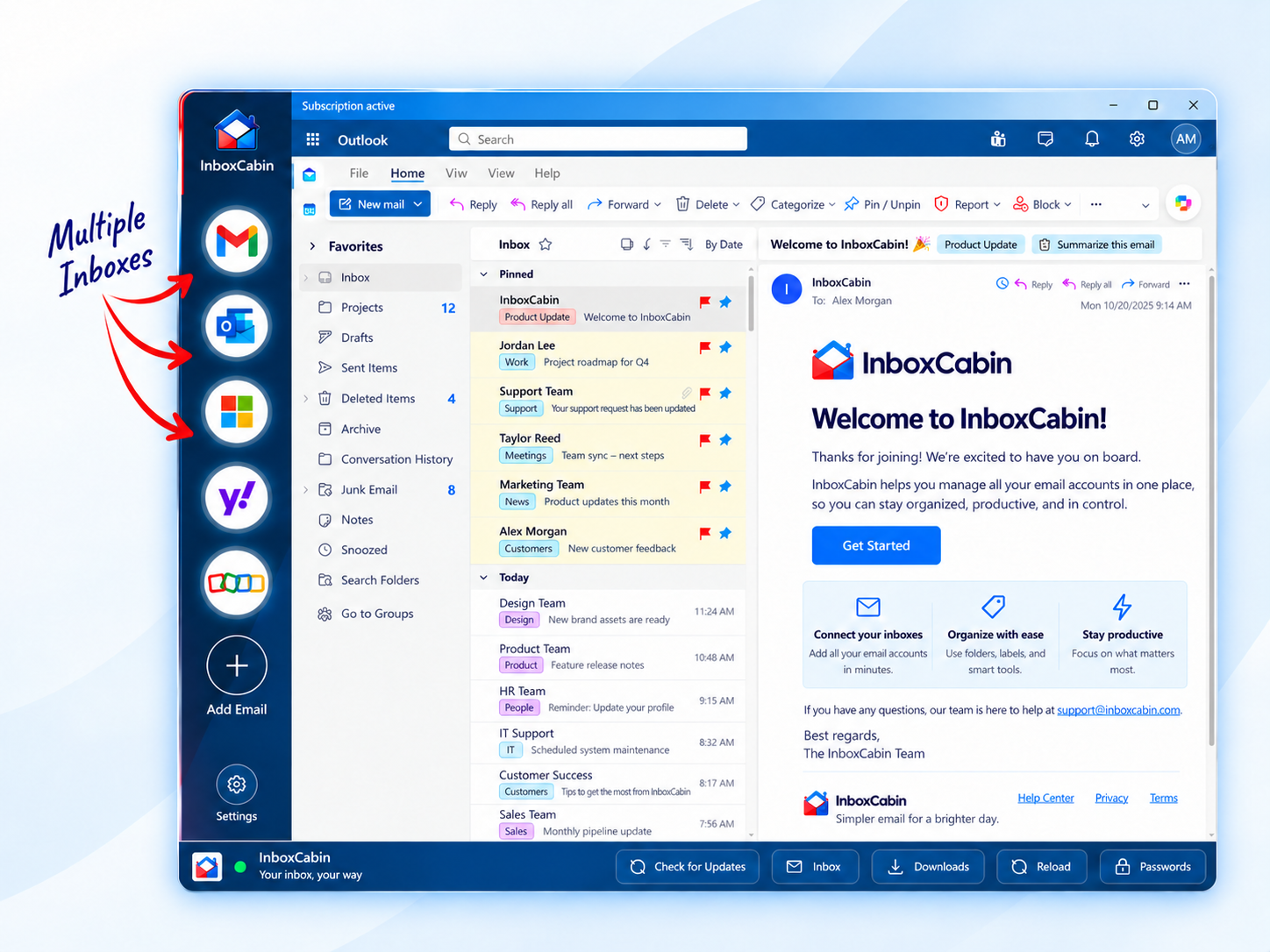
Another failure mode is tool-first thinking: buying a new communication product before deciding what problem it should solve. InboxCabin helps people keep several Gmail and Microsoft inboxes available in a dedicated Windows app. It does not automatically decide who owns a customer request, generate the correct escalation policy, eliminate spam or guarantee that every account stays authenticated forever.
Also avoid confusing lower message volume with better business performance. Sometimes the right intervention generates more communication—for example, a safety incident reported earlier, a clarifying question asked sooner, or a decision logged properly. Quality, accountability and employee recovery should remain part of the evaluation.
How InboxCabin fits into the broader system
InboxCabin is best viewed as an email workspace layer. It can make separately signed-in Gmail and Microsoft webmail accounts easier to find and switch between while leaving the ordinary browser for research, documents, chat and everything else. It is not a unified email database, a help-desk ticketing system or an organizational analytics platform.
In a workflow concerned with written handoffs, that separation can be convenient: a designated monitor can keep work inboxes accessible without rebuilding a maze of general-purpose browser profiles. Whether it helps performance is a matter for the team’s own measurement, not a claim established by the studies cited above.
Keep authentication and security boundaries in place. Provider sign-in and MFA still apply, and managed corporate accounts may require approved devices or applications. Do not ask employees to share passwords to simplify access. Organizational ownership, delegation and audit policies should be decided by the company and its administrators.
A simple implementation checklist
-
Write a plain-language definition of the problem and the consequence of doing nothing.
-
Pick one team, workflow or account group for a limited test rather than changing everything at once.
-
Name who monitors urgent requests and how exceptions are escalated.
-
Record both speed and quality measures, including missed or reopened work.
-
Check employees’ experience and customer outcomes before declaring the pilot successful.
-
Document the revised procedure and assign an owner for reviewing it next month.
Related guides
- Communication Debt: Why Important Decisions Disappear Inside Email
- Async-First Decision Memos: A Better Alternative to Endless Reply-All Chains
Explore InboxCabin for separately accessible Gmail and Microsoft inboxes on Windows, or read our introduction to InboxCabin.
Conclusion
A written handoff can reduce coordination cost, but only if it contains the information a receiver needs to act without playing detective. The research is valuable because it clarifies mechanisms and tradeoffs, not because it supplies a universal formula. The most reliable next step is a small, measured change that preserves your obligations while reducing avoidable friction.
If you manage several Gmail or Outlook identities, a focused email workspace can be one practical component of that system. Keep the tool’s role modest and the process explicit: right message, right owner, right time, and fewer unnecessary demands on everyone else’s attention.
Try InboxCabin free for 30 days. No credit card required.
Sources and research notes
These references are presented so readers can review the original research and its limitations. The operational framework in this article is an editorial application of the research, not a tested InboxCabin intervention.
-
Laker et al. (2022), The Surprising Impact of Meeting-Free Days. An MIT Sloan Management Review analysis discusses how meeting-free periods can help focus and collaboration when tailored to an organization. Management analysis, not universally generalizable randomized evidence for a fixed number of no-meeting days.
-
The effect of co-location on human communication networks (2022). Researchers analyzed large communication-network patterns at MIT during a remote-work transition, illustrating how work setting and network structure can change information flow. Observational institutional context; do not generalize directly to commercial teams or a single tool.
-
Edmondson (1999), Psychological safety and learning behavior in work teams. A field study across 51 work teams found psychological safety associated with learning behavior and team performance processes. Associations in a specific manufacturing context; not a test of email rules or any collaboration software.
Scenarios and office images are illustrative, not customer cases. The cited studies did not test InboxCabin; workflow recommendations are editorial applications, not guaranteed results.