

People can leave an email window physically while still mentally rehearsing a reply, worrying about an unanswered question, or waiting for a decision.
One way to judge a communication system is to watch what happens on a particularly busy Tuesday. If every message creates a fresh decision about urgency, the system is asking employees to do design work all day.
Consider this situation: A founder writes a proposal immediately after reading an unresolved customer complaint. The proposal window is active, but the unanswered complaint keeps resurfacing in thought. It helps separate a visible symptom from the less visible organizational cost. If the problem is communication design, adding another tool without changing the underlying rules may make the problem harder rather than easier.
The goal of this guide is to do three things: explain the mechanisms supported by research, show exactly how to run a practical test, and clarify what the evidence does not yet establish. Recommendations are presented as operating hypotheses, not guaranteed returns on software spending.

Try InboxCabin free for 30 days. No credit card required.
 Start Free Trial
The workplace problem
Treat open loops as a capture problem rather than a willpower problem. A thread does not have to be resolved before focus work, but its next owner and next decision should be explicit.
In the example above, the important question is not merely how often someone opened email. It is which event caused a work transition, what that person had to reconstruct, and whether the request was actually urgent. A message about tomorrow’s routine scheduling can be queued; a time-sensitive safety or client issue needs an owner now. Both may arrive in an inbox, but they should not create identical behavior.
What the research shows
Leroy (2009), Why is it so hard to do my work? Attention residue is one useful point of reference. In that work, laboratory experiments found that unfinished prior tasks can leave attention focused on the first task, impairing performance on the next. Controlled tasks are not directly equivalent to an inbox full of real client requests; the result supports managing transitions, not a universal minutes-lost formula. The paper is relevant because it tests or documents a mechanism behind today’s digital work habits, not because it investigated InboxCabin.
A second perspective comes from Mark, Gudith & Klocke (2008), The cost of interrupted work. Here, interrupted participants sometimes completed tasks faster at similar quality, but reported higher stress, frustration, time pressure, and effort. The paper does not claim that every interruption makes work slower; its stress findings are just as important as completion time. These findings should not be flattened into a headline promising that one workflow produces the same result for all roles.
Strong evidence does not necessarily mean a large or universal effect. Many of the studies below examine one mechanism—stress, interruption, focus or organizational change—rather than a complete business outcome.
For that reason, read the linked original study when making high-stakes policies. Distinguish experimental manipulation, survey association, company telemetry and expert analysis. Treat sample size, context and measurement as part of the result, not footnotes to be skipped.
A practical framework for unfinished email threads
Start with one narrow workflow rather than a company-wide rule. Write down the task, the intended audience, the observable problem, and the exception that would make the proposed change unsafe. The following steps make the intervention concrete enough that a colleague could run it without guessing what you meant.
Step 1: Move unresolved messages into a waiting-for list with owner and date rather than rereading the same thread
Step 2: Write a one-sentence next action such as “confirm scope with Maya by Tuesday,” not “follow up
Write a one-sentence next action such as “confirm scope with Maya by Tuesday,” not “follow up.”
Step 3: End each triage block with a two-minute closure ritual: capture, flag, schedule, close
Step 4: Begin deep work from a written first step so the prior topic has less opportunity to reclaim attention
An illustrative scenario: from symptoms to decisions
An analyst with seven open client threads records next actions for each in a task list; two need a call, four need a reply, and one needs no action until Friday. That classification gives attention something concrete to release.
To turn the example into a real measurement, record a baseline first. A simple spreadsheet can capture daily demand, the number of meaningful actions completed, repeated clarification requests, exceptional incidents, and self-rated ease of work. The baseline should cover typical days, not just a quiet Friday or a crisis Monday.
Do not manufacture savings by assigning a fixed number of minutes to every interruption or comparing unlike weeks. If one week includes a product launch and the next does not, a straightforward before-and-after comparison is misleading. Keep the calculation transparent and show uncertainty when the evidence is thin.
One particularly useful metric is rework: how often did the team revisit a message, reopen a decision, correct a mistake or ask for a detail that should have been in the first handoff? Rework is often a better leading indicator of communication friction than total email count. It also provides a concrete way to improve the process without treating individual workers as the problem.
A measured pilot for unfinished email threads
For two weeks, alternate between a normal transition and a recorded next-action transition. Ask whether restarting the main task felt easier; compare missed follow-ups separately.
Agree on a success definition before starting. For instance, a team might require customer response time to remain within its current service obligation, staff-reported interruptions to decline, and avoidable corrections not to rise. A change fails the test if it improves the easiest metric while materially harming a more important one.
Where possible, compare similar work periods or alternate conditions in a planned sequence. Make the evaluation auditable: note who participated, what exceptions occurred, which weeks were unusually busy and which data sources were used. When sample sizes are small, qualitative notes may be more informative than a percentage with false precision.
Invite frontline staff to identify side effects. They can tell you whether a nominally simpler system pushed work into another channel, increased phone calls or created an untracked queue. Manager approval alone does not establish success. Teams should have a clear way to report breakdowns without being blamed for them.
Tradeoffs, unintended consequences and exclusions
A capture ritual is a practical hypothesis, not an intervention validated specifically for InboxCabin.
Do not promise that a specific desktop application changes the underlying volume of incoming mail, the content of messages, or provider authentication rules. Tools and policies solve different layers of the problem.
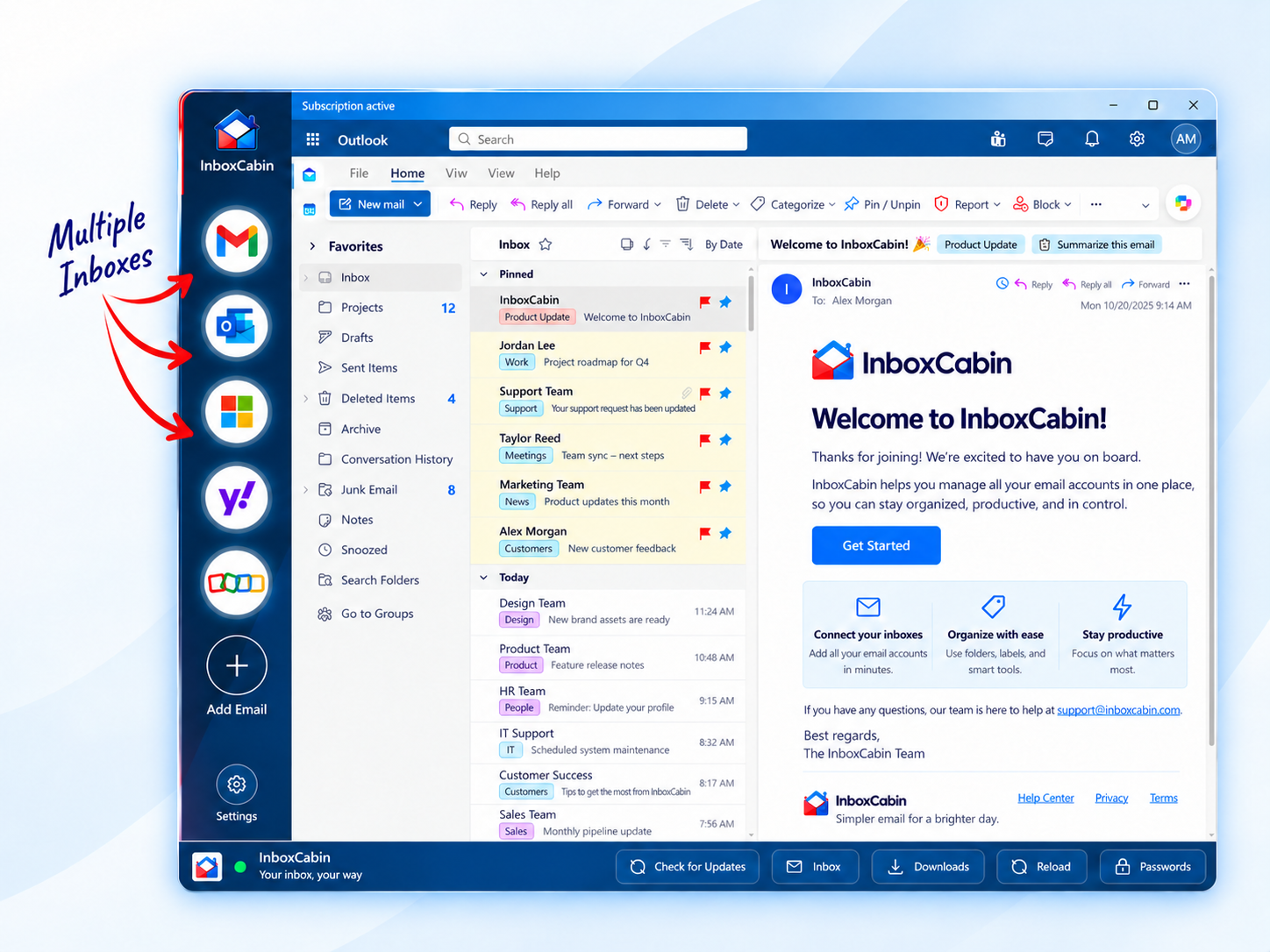
Another failure mode is tool-first thinking: buying a new communication product before deciding what problem it should solve. InboxCabin helps people keep several Gmail and Microsoft inboxes available in a dedicated Windows app. It does not automatically decide who owns a customer request, generate the correct escalation policy, eliminate spam or guarantee that every account stays authenticated forever.
Also avoid confusing lower message volume with better business performance. Sometimes the right intervention generates more communication—for example, a safety incident reported earlier, a clarifying question asked sooner, or a decision logged properly. Quality, accountability and employee recovery should remain part of the evaluation.
How InboxCabin fits into the broader system
InboxCabin is best viewed as an email workspace layer. It can make separately signed-in Gmail and Microsoft webmail accounts easier to find and switch between while leaving the ordinary browser for research, documents, chat and everything else. It is not a unified email database, a help-desk ticketing system or an organizational analytics platform.
In a workflow concerned with unfinished email threads, that separation can be convenient: a designated monitor can keep work inboxes accessible without rebuilding a maze of general-purpose browser profiles. Whether it helps performance is a matter for the team’s own measurement, not a claim established by the studies cited above.
Keep authentication and security boundaries in place. Provider sign-in and MFA still apply, and managed corporate accounts may require approved devices or applications. Do not ask employees to share passwords to simplify access. Organizational ownership, delegation and audit policies should be decided by the company and its administrators.
A simple implementation checklist
-
Write a plain-language definition of the problem and the consequence of doing nothing.
-
Pick one team, workflow or account group for a limited test rather than changing everything at once.
-
Name who monitors urgent requests and how exceptions are escalated.
-
Record both speed and quality measures, including missed or reopened work.
-
Check employees’ experience and customer outcomes before declaring the pilot successful.
-
Document the revised procedure and assign an owner for reviewing it next month.
Related guides
- The Hidden Cost of Digital Interruptions at Work: What the Research Really Shows
- How to Protect Meeting-Free Focus Time Without Ignoring Customers
Explore InboxCabin for separately accessible Gmail and Microsoft inboxes on Windows, or read our introduction to InboxCabin.
Conclusion
People can leave an email window physically while still mentally rehearsing a reply, worrying about an unanswered question, or waiting for a decision. The research is valuable because it clarifies mechanisms and tradeoffs, not because it supplies a universal formula. The most reliable next step is a small, measured change that preserves your obligations while reducing avoidable friction.
If you manage several Gmail or Outlook identities, a focused email workspace can be one practical component of that system. Keep the tool’s role modest and the process explicit: right message, right owner, right time, and fewer unnecessary demands on everyone else’s attention.
Try InboxCabin free for 30 days. No credit card required.
Sources and research notes
These references are presented so readers can review the original research and its limitations. The operational framework in this article is an editorial application of the research, not a tested InboxCabin intervention.
-
Leroy (2009), Why is it so hard to do my work? Attention residue. Laboratory experiments found that unfinished prior tasks can leave attention focused on the first task, impairing performance on the next. Controlled tasks are not directly equivalent to an inbox full of real client requests; the result supports managing transitions, not a universal minutes-lost formula.
-
Mark, Gudith & Klocke (2008), The cost of interrupted work. Interrupted participants sometimes completed tasks faster at similar quality, but reported higher stress, frustration, time pressure, and effort. The paper does not claim that every interruption makes work slower; its stress findings are just as important as completion time.
Scenarios and office images are illustrative, not customer cases. The cited studies did not test InboxCabin; workflow recommendations are editorial applications, not guaranteed results.